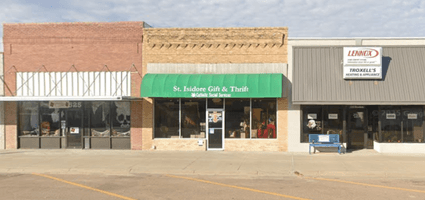
Our location
Imperial/McCook Programs
Family Support Services
Serving Chase, Dundy, Frontier, Hays, Hitchcock, Lincoln, Perkins, and Red Willow counties
Please contact Family Support Services Specialist Jennifer Hinze at 531.484.3566 or jhinze@csshope.org to learn more.
Food Pantry
Food assistance is available for those in need. To request help, or for more information, contact Family Support Services Specialist Jennifer Hinze at 531.484.3566 or jhinze@csshope.org to learn more.
Immigration Legal Services
Catholic Social Services of Southern Nebraska is certified by the Department of Justice to practice immigration law as authorized representatives. Forms include:
- Permanent Residency
- Naturalization
- DACA
and more. Spanish interpretation is available upon request. To speak with our Immigration Legal Services Program, please call 402.327.6244
Support CSS Imperial/McCook
Donate Items
Please call our store (308.882.3065) for our current donation guidelines.
Donate Money
Your gifts, both large and small, will help us bring Hope in the Good Life to those we help together in the 8-county area served by our outreach office. Click here to donate online.
Volunteer
We offer many opportunities for individuals, families, and parish communities to serve those in need. Ultimately, we are about service to one another: the disabled, the aged, the newcomer, and the poor among us.
Join us! To get started, please fill out our simple online volunteer application by clicking here.
The latest CSS Imperial/McCook News

By Julie Perry,
St. Francis Gift and Thrift Store Manager
By definition, a volunteer is a person who freely offers to take part in an enterprise or undertake a task. At Catholic Social Services of Southern Nebraska (CSS), it is so much more. It is showing up with heart and compassion, and serving with CSS’s core values of Dignity, Integrity, Empathy, Trust, and Sustainability.

By Katie Patrick
Two weeks ago, I shared the story of a young woman who was living in an unsafe situation. Her mom reached out to me on Christmas Eve begging for local resources that could help her daughter. The parents lived in another state, and with a little more information, I gathered that the daughter was a drug user and the parents forbade drug use in the home.
While there may have been other reasons that the daughter chose to live in a city a thousand miles away, the reality of her being so far from her family—her natural safety net—caused deep physical and emotional distress. In other words, due to distance and previously severed relationships, the crisis displaced the family as the primary responder. When this happens, neighbors and the local community become the next line of support—followed by organizations.

By Katie Patrick
Neighbors helping neighbors.
Over the past few weeks, this phrase has been heard frequently alongside victims and state leaders alike, as they talked about the largest wildfire in our state’s history. More than 800,000 acres burned in the Nebraska wildfires, affecting fields and displacing cattle at all stages of operations— disrupting herd management, altering breeding and nutritional patterns, rotational grazing and much more.
Yet, it seems that at every stage, help came from neighbors—whether those in close proximity to the fires, whose land was spared, or those in neighboring states who stepped up to help. This is what Nebraska is all about—resilience and compassion.